On July 4, 2025, Enable Earth and King Mongkut’s University of Technology Thonburi (KMUTT) have officially signed a Memorandum of Understanding (MOU) to collaborate on “Academic and Innovation Support in Environmental Management and Biochar.” The partnership marks a milestone in advancing environmental innovation and tackling one of Northern Thailand’s most pressing challenges — PM2.5 air pollution— while promoting circular and low-carbon development in rural communities.
The MOU was signed by Assoc. Prof. Dr. Suvit Saetia, President of KMUTT, and Ms. Pasinee Tangsuriyapaisan, CEO of Enable Earth, with Ms. Darin Rangsikamol, Tech Lead of Enable Earth, and Mr. Suren Thapanangkoon, Director of the Center for Promotion and Support of the Royal Project Foundation and Royal-Initiated Projects at KMUTT, serving as witnesses.
Driving Innovation for Cleaner Air and Sustainable Agriculture
This collaboration aims to address the long-standing PM2.5 pollution crisis in Northern Thailand—particularly in Wiang Pa Pao District, Chiang Rai Province—by transferring environmental knowledge and innovations directly to local communities. Through this joint initiative, farmers will be supported to manage agricultural residues such as corn stalks, rice straw, and other biomass wastes more efficiently, transforming them into biochar, a carbon-negative material that improves soil fertility, reduces open burning, and creates new commercial value.
A Public–Private–People Partnership (PPP) Model for Impact
Assoc. Prof. Dr. Suvit Saetia emphasized,
“This partnership represents a significant step in realizing the university’s mission to drive academic engagement for societal benefit. KMUTT is proud to co-develop this PPP model (Public–Private–People Participation) that brings together the power of government, private sector, and local communities toward sustainable development.”
Innovation and Circular Economy at the Core
Ms. Pasinee Tangsuriyapaisan added,
“Enable Earth is committed to advancing environmental innovation through biochar technology, which not only reduces agricultural waste and open burning—the root cause of PM2.5—but also unlocks new opportunities for community-based businesses and long-term sustainability.”
Toward a Low-Carbon Future
Representatives from KMUTT’s Pilot Plant Development and Training Institute (PDTI), School of Energy, Environment and Materials, The Joint Graduate School of Energy and Environment (JGSEE), Business Development Working Group, and the Center for Research and Community Services also joined the signing ceremony. The MOU will span three years, with the shared goal of developing the “Wiang Pa Pao Biochar Project” as a national model that can be replicated across Thailand. The collaboration further supports Thailand’s transition toward a low-carbon economy and contributes to achieving the United Nations Sustainable Development Goals (SDGs).
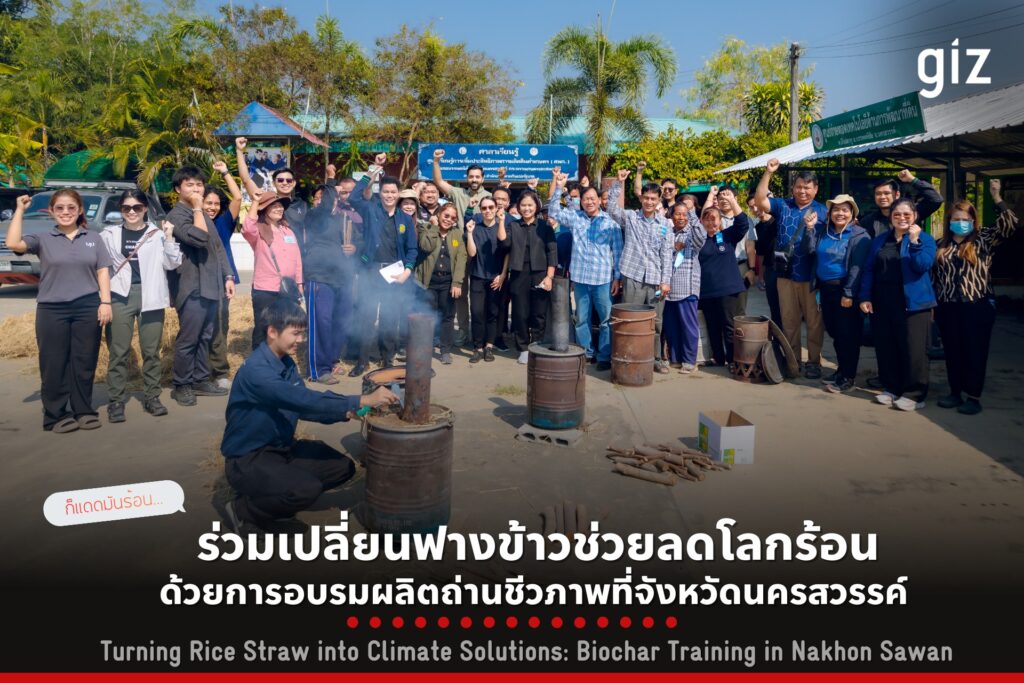
On 14 January 2026, the TGC EMC project (Thai-German Cooperation on Energy, Mobility and Climate), implemented by GIZ Thailand (German Agency for International Cooperation), together with Planet2050 and Enable Earth, held a hands-on biochar training with 17 selected farmers in Nakhon Sawan, focusing on turning rice straw, which is often burned after harvest, into a valuable resource. With PM2.5 levels currently rising across the country, agricultural residue burning is one of the major sources of air pollution in Thailand.
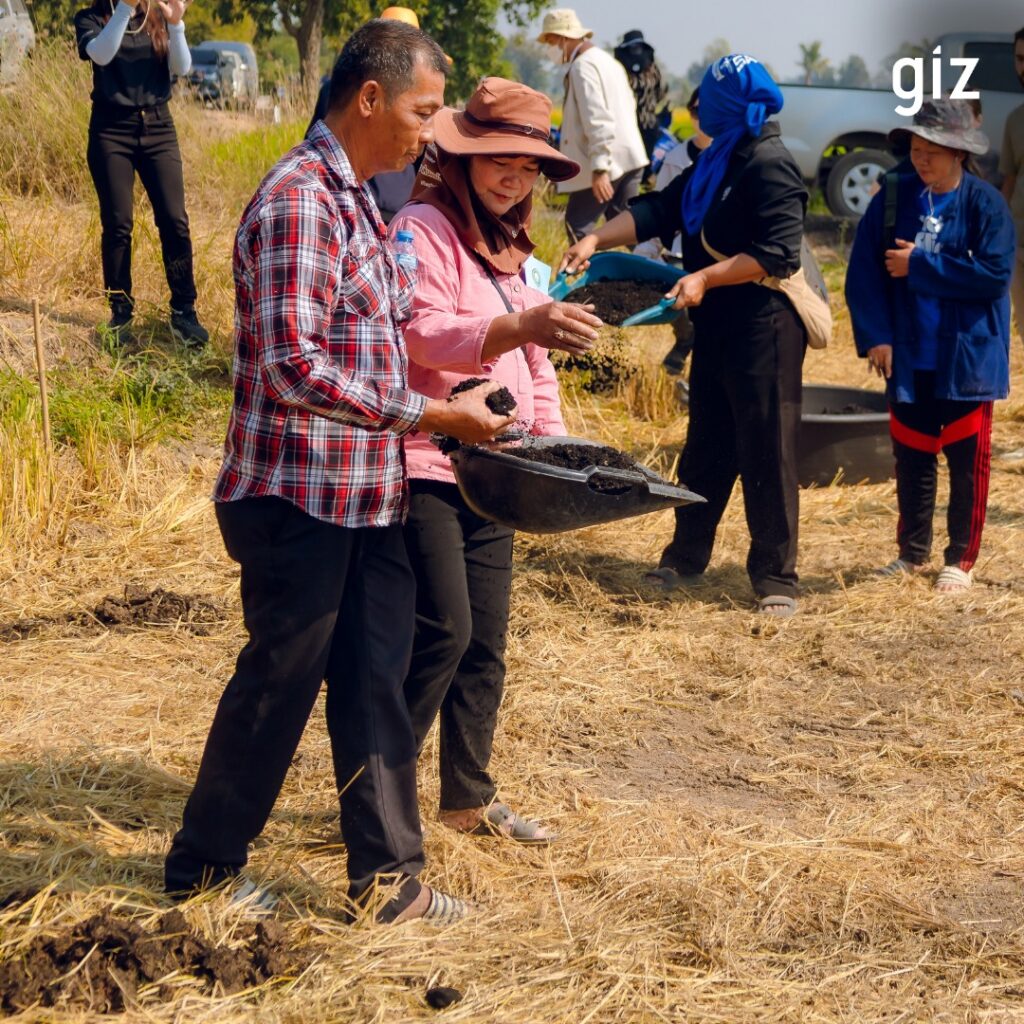
Farmers learned practical techniques to convert this agricultural residue into biochar and how to apply it to their soils. Biochar can significantly improve soil health by enhancing water retention, nutrient availability, and microbial activity. Beyond agriculture, it also has versatile applications, including in construction materials and other industrial products.
Most importantly, biochar offers a double climate benefit: it reduces emissions from open burning and locks carbon into a stable form for hundreds years. However, running such as activities is often not financially viable for farmers. New finance mechanisms now make this possible, especially in global carbon markets, where companies are turning to high-integrity, durable Carbon Dioxide Removal (CDR) certificates to support their net-zero strategies.
This training marked an important first step toward producing biochar from rice straw at a larger scale. Stay tuned to see how Nakhon Sawan is finding sustainable solutions for its agricultural residues!
Enable Earth joined forces with our incredible partner, the German-Thai Agricultural Cooperation (GETHAC), for the final pitch round of the AgriSpark Hackathon – Hack the Hills!, held during the AGRIFUTURE Conference & Exhibition 2025, organized by the German Agricultural Society (DLG Asia Pacific).
AGRIFUTURE is one of Asia’s leading agricultural innovation events, bringing together experts, entrepreneurs, policymakers, and investors to explore technologies and solutions that drive the future of sustainable farming across the region.
💡 Congratulations to all 8 finalist teams for bringing such high-energy and high-impact ideas to the stage! The AgriSpark Hackathon was launched to spark collaboration between farmers, startups, engineers, and innovators in tackling Thailand’s most pressing agricultural challenges—especially the open burning of crop residues on steep terrains. Through real-world use cases, participants worked to design practical, scalable solutions that enhance circularity, reduce pollution, and improve rural livelihoods.
This year’s challenges focused on: • Use Case 1: From Hill to Road 🚜 — developing solutions for biomass collection and transportation from steep, hard-to-access fields. • Use Case 2: Burn No More 🔥 — finding viable alternatives to open burning that turn residues into valuable resources.
When we first began exploring this challenge a year ago—mapping steep terrains, testing residue-collection methods, and seeking partners to help us build solutions that go beyond policy—it seemed almost impossible to shift such an entrenched system. But meeting GETHAC and finding partners who shared our belief that open burning can be avoided—with the right mix of innovation, collaboration, and persistence—gave us the momentum to bring this Hackathon to life.
This is just the beginning. Together, we’ll keep driving forward to turn these ideas into real, sustainable impact—one hillside at a time. 💪