PM2.5 Does Not Just Come From Cars: The Agricultural Waste Problem Thailand Stopped Talking About
After the harvest, the fields burn. Where the haze really comes from, what it costs, and the alternative that turns smoke into stored carbon.
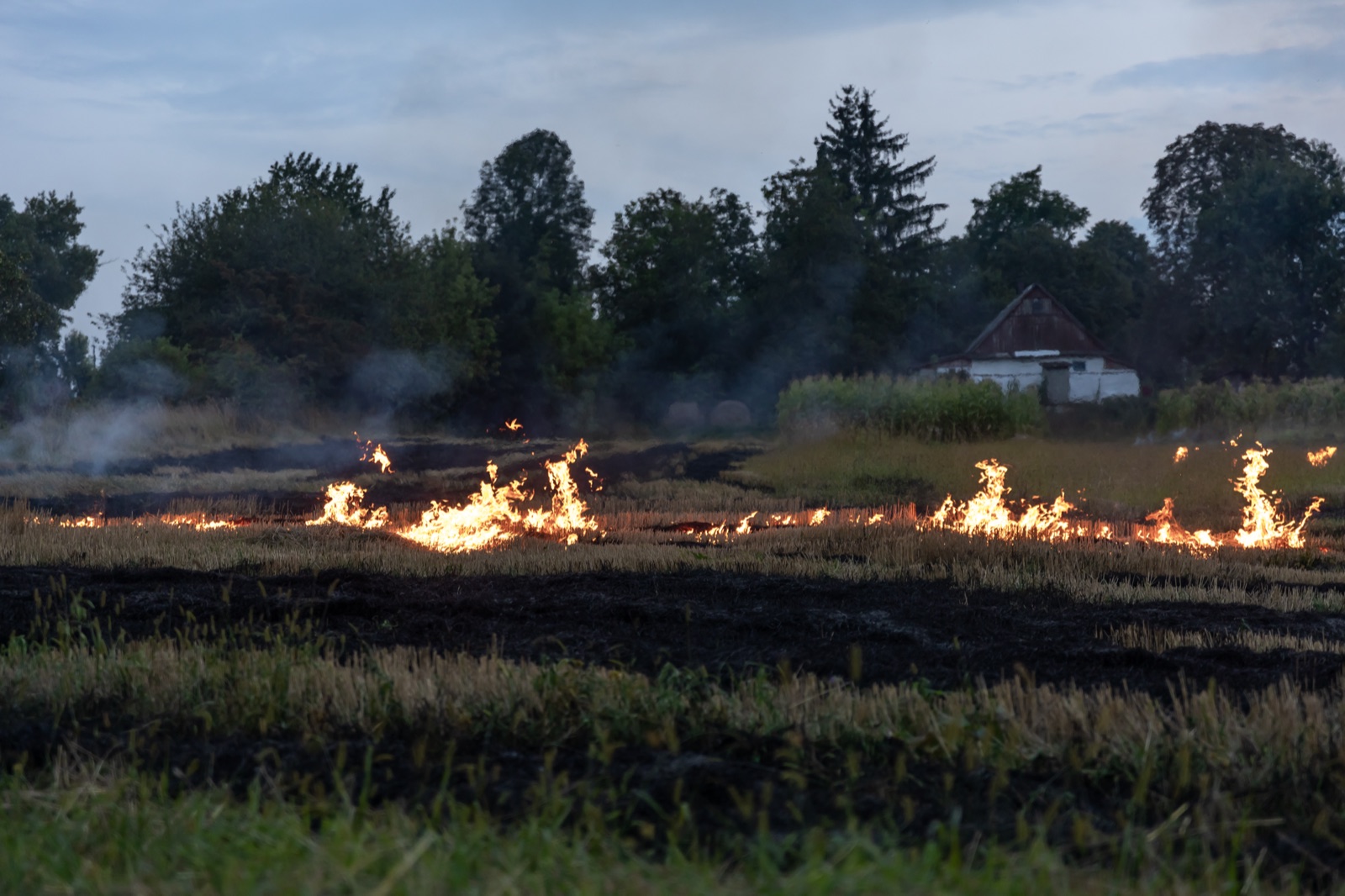
Every year between January and April, the north of Thailand slowly disappears. Chiang Mai, Chiang Rai, and the valleys around them vanish into a flat grey haze. The mountains go missing. The sun turns pale. Air quality readings climb into the range where simply breathing outside is a measurable health risk.
Ask most people what causes it and the answer comes quickly: traffic and factories. Both play a part. But a large share of that haze does not come from the city at all. It drifts in from the fields. In the northern provinces the dominant agricultural source is corn stalk burning after the maize harvest. In Central Thailand and the Northeast the same problem wears a different face: it is rice straw that gets set alight after the rice cut. Different crop, same fire, same fine particulate matter in the air.
The number nobody wants to look at
After every harvest, Thailand's farms are left covered in residue: rice straw and stubble, maize stalks, sugarcane leaves. There is an enormous amount of it. Thailand's Department of Agricultural Extension estimated that in just the February-to-April window, the country generated around 48.6 million tonnes of crop residue. Across a full year, rice, maize, and sugarcane alone cover roughly 96.8 million rai and produce about 114 million tonnes of leftover material.
A great deal of that is set alight. Thailand burns well over 4 million tonnes of rice straw every year.
48.6 million tonnes of crop residue generated in a single February-to-April window. The question is not whether there is a lot of residue. It is what happens to it.
It is worth being fair about why. For a smallholder, burning is free, fast, and effective. It clears a field in an afternoon and makes way for the next planting in a turnaround often measured in days, not weeks. There is rarely a machine, a buyer, or a storage option waiting as an alternative. Given those constraints, burning is not laziness. It is the rational choice in a system that has not yet offered a better one.
What the fire actually costs
The most visible cost is human. The fine particulate matter known as PM2.5 is small enough to pass deep into the lungs and into the bloodstream. Burning season in northern Thailand brings rises in respiratory illness, hospital visits, and lost school and working days across whole provinces.
There is a second cost that is easier to ignore because you cannot see it. Open burning is also a climate problem. It releases carbon dioxide, nitrous oxide, and methane, a gas with roughly 28 times the warming power of carbon dioxide over a century. One spatial study of residue burning across Thailand's rice, maize, and sugarcane land estimated annual emissions on the order of 800,000 tonnes of carbon dioxide equivalent.
And there is a third cost, the one that should bother an economist most. Burning destroys value. Every tonne of straw contains carbon, nutrients, and structure. Set it on fire and all of it is gone in an afternoon, converted into a public health crisis instead of a usable resource.
The residue was never the problem
Here is the reframe that changes the whole conversation. Crop residue is not waste. It is biomass: carbon, silica, and structure, produced in vast and reliable quantities every single season.
The problem has never been the residue. The problem is the fire. The exact same tonne of straw or stalks can become a haze of PM2.5 hanging over a city, or it can become a raw material. Nothing about the material decides which. Only what we choose to do with it does.
A different ending for the same harvest
There is an alternative to the match, and it is not complicated in principle. Instead of burning crop residue in open air, it can be put through pyrolysis: heated in a controlled, low-oxygen system that converts it into biochar rather than smoke.
The difference in outcome is stark. No open plume of fine particulates over farmland and towns. And instead of the residue's carbon being dumped into the atmosphere, a large share of it is locked into a stable solid that can be returned to the soil and kept underground for a century or more.
This is the work Enable Earth is building in the north of Thailand: industrial-scale conversion of agricultural residue into biochar, designed to give that material somewhere to go other than up in smoke.
The wider system is starting to move in the same direction. Thailand's 2025/2026 action plan sets a target of cutting agricultural burning by at least 15 percent for major crops. The Pollution Control Department and provincial authorities are tightening enforcement during high-haze months. The direction of travel is set. What matters now is scale.
What actually has to change
The solution is not a poster telling farmers to stop burning. Farmers already know the haze is harmful. They breathe it too. Telling people to stop a practice without giving them an alternative simply does not work, and it never has.
What changes the outcome is infrastructure. The residue needs somewhere to go: a way to collect and aggregate it, a system to move it, a facility that converts it, and a real market for the biochar at the end. Make the residue worth more in the field than it is worth as ash, and the fire goes out on its own.
The haze over northern Thailand can feel like a fixed feature of the calendar, as inevitable as the season itself. It is not. It is the visible result of a system that has not yet been redesigned. And a design problem, unlike the weather, is something that can be solved.